
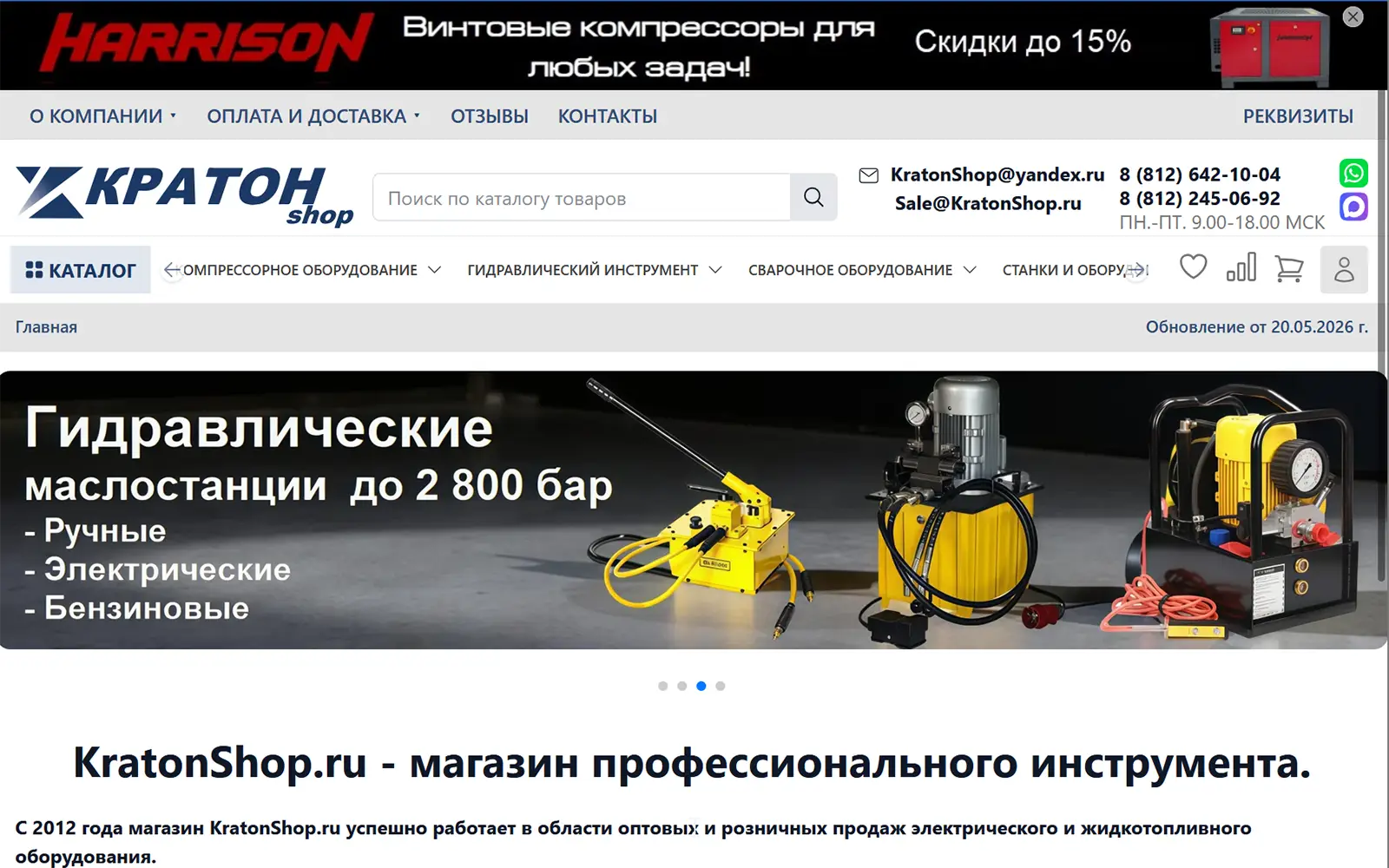
Where we started
KratonShop sells professional and household equipment. The store ran on the Korsite system: the owner added products by hand and performed many catalog operations manually.
The mobile version and on-site search optimisation needed work, and the pages had no structured data. The store was moved to Laravel — and the catalog was built anew.
A catalog where products are chosen by specifications
The catalog holds more than ten thousand items — from band saws to screw compressors. A buyer of such equipment rarely knows the model. They know the task: a 220-volt machine for a workpiece of a given diameter, a compressor with the right output. So selection by specifications became the centrepiece of the new store.
The work had to start with the data. Part of the specifications lived as lines in the product description: readable, but impossible to filter by. We moved them into separate fields, merged duplicates and brought the units of measurement to common ones.
Filters are not drawn separately for each page. The set is assembled from the specifications of the products in a section, and the owner marks in the admin panel which of them to filter by and in what order to show them.
How selection works
-
Each section has its own set
Band saws have workpiece diameter and profile size, compressors have output and receiver volume. Nothing superfluous in the list.
-
Sliders with real bounds
The range comes from the products in the section: band saw power runs from 250 to 7,500 W, not from zero to infinity.
-
A counter next to every value
Each option shows how many products stand behind it: 220 V — 115, 380 V — 332.
-
No empty filters
A value with no products behind it is not shown. A filter with nothing to choose from is hidden altogether.
-
Search inside a long list
When there are dozens of values — profile sizes, brands — the right one is found by searching the list or expanding it in full.
-
A selection is a link
The chosen filters are written into the page address: a selection can be sent to a colleague or pasted into a quote.
-
The essentials are visible in the list
A product card right in the catalog shows the same specifications the filters work with. Products can be compared without opening every page.
-
Search understands Cyrillic spelling
Two thirds of the brands in the catalog are written in Latin letters, but people type them as they hear them. The Russian query "хансман" finds Hansmann.
Three sections — three different sets
Metal band saws
448 products
- Voltage
- Power, W
- Max. workpiece diameter
- Max. profile size
Belt-driven compressors
212 products
- Output, l/min
- Receiver volume, l
- Voltage
Electric screw compressors
860 products
- Output, l/min
- Pressure, bar
- Drive type
- Protection rating
- Frequency converter
Price and brand are present in every section. Product counts as of 18 November 2026.
What was done with the data
- Before: Specifications as lines in the product description
- After: Separate fields the filter works with
- Before: Engine power written as text
- After: A number — and the filter became a slider
- Before: Two different "Voltage" attributes on products
- After: One specification for the whole catalog
- Before: Watts and kilowatts mixed together
- After: One storage unit, and in each section the one buyers are used to
Check. Checked on 18 November 2026 on the live site: the metal band saws section holds 448 products; a link with the "220 V" filter selected opens a selection of 115 products — exactly what the counter next to that value shows; the query "хансман" finds Hansmann products.
The move: keeping old links pointed at products
In January 2026 the store switched to the new version. Before the switch the owner worried most about old links: a person arriving from Yandex or Google should land on the right product, not on the home page or an error page.
All previous addresses were matched to the new pages. After launch we separately fixed the links to product PDF documents and worked through remarks together with the owner as they came up.
The customer confirmed the result: search traffic was preserved after the move, and the number of visitors did not drop.
Check. Checked on 18 November 2026 on the live site: an old-style address — a page name with the .html extension — answers with a permanent redirect to the new category or product page; an address that never existed answers "not found" instead of sending the visitor to the home page.
A product feed Yandex accepted
After the move Yandex rejected the product feed. We analysed the offer format, changed how the feed is built and sent it for a repeat check.
In the Yandex Products dashboard on 6 January 2026 the check showed 8,384 offers — all without errors. The catalog has grown since then.
Check. Checked on 18 November 2026: the store’s published feed holds more than 10,300 offers.
The order email and small automation
We clarified what goes into the lead and order email: buyer and company details, the address if it is given, a clear indication of delivery. The owner confirmed that this is enough for the accountant.
A separate small improvement was the address of a new product page: it used to be typed by hand, now it is filled in automatically.
The work did not end at launch
Next came the tasks a running store produces: product images, "price on request", new filters. The delivery calculation from an external service now loads when the buyer opens the delivery tab and no longer delays the product description.
The owner told us that buyers did not notice the horizontal scroll of the specifications table and asked where the product’s technical data was. On a phone the name of a specification now sits above its value, and the table no longer has to be dragged sideways. The owner checked the result on his own phone and approved it.
For new features — managing page blocks, for example — we prepared explanations so that the owner could use them on his own.
Check. Checked on 18 November 2026: the product page on the live site carries structured data about the product — name, price, availability — and a breadcrumb trail.